Table Of Content
In this chapter, we look closely at how and why researchers combine these basic elements into more complex designs. We start with complex experiments—considering first the inclusion of multiple dependent variables and then the inclusion of multiple independent variables. For the vast majority of factorial experiments, each factor has only two levels.
Mathematical Model
If we made a separate graph for the main effect of shoes we should see a difference of 1 inch between conditions. Similarly, if we made a separate graph for the main effect of hats then we should see a difference of 6 between conditions. In addition, SuperGym offers 4 different workout plans, A through D, none of which are directly catered to any of the different types. Create an experimental factorial design that could be used to test the effects of the different workout plans on the different types of people at the gym.
Non-Experimental Studies With Factorial Designs
For example, the very same pattern of data can be displayed in a bar graph, line graph, or table of means. These different formats can make the data look different, even though the pattern in the data is the same. An important skill to develop is the ability to identify the patterns in the data, regardless of the format they are presented in. Some examples of bar and line graphs are presented in the margin, and two example tables are presented below. As expected, we the average height is 6 inches taller when the subjects wear a hat vs. do not wear a hat.
Quantitative Research – Methods, Types and...
The figure below contains the DOE table of trials including the two responses. Minitab 15 Statistical Software is a powerful statistics program capable of performing regressions, ANOVA, control charts, DOE, and much more. Minitab is especially useful for creating and analyzing the results for DOE studies. It is possible to create factorial, response surface, mixture, and taguchi method DOEs in Minitab. Ignoring the first row, look in the last stage and find the variable that has the largest relative number, then that row indicates the MAIN TOTAL EFFECT.
V. Chapter 5: Experimental Research
Experimental design provides a structured approach to designing and conducting experiments, ensuring that the results are reliable and valid. The purpose of experimental design is to control and manipulate one or more independent variables to determine their effect on a dependent variable. Experimental design allows researchers to systematically investigate causal relationships between variables, and to establish cause-and-effect relationships between the independent and dependent variables. Through experimental design, researchers can test hypotheses and make inferences about the population from which the sample was drawn. This experimental design method involves manipulating multiple independent variables simultaneously to investigate their combined effects on the dependent variable.
Setting Up a Factorial Experiment
Optimization of ICP-MS internal standardization for 26 elements by factorial design experiment - ScienceDirect.com
Optimization of ICP-MS internal standardization for 26 elements by factorial design experiment.
Posted: Sun, 23 Apr 2023 07:26:16 GMT [source]
But factorial designs can also include only non-manipulated independent variables, in which case they are no longer experiments but are instead non-experimental in nature. Such studies are extremely common, and there are several points worth making about them. First, non-manipulated independent variables are usually participant variables (private body consciousness, hypochondriasis, self-esteem, gender, and so on), and as such, they are by definition between-subjects factors. For example, people are either low in hypochondriasis or high in hypochondriasis; they cannot be tested in both of these conditions. Second, such studies are generally considered to be experiments as long as at least one independent variable is manipulated, regardless of how many non-manipulated independent variables are included. Third, it is important to remember that causal conclusions can only be drawn about the manipulated independent variable.
Optimization of coagulation-flocculation for landfill leachate treatment: An experimental design approach using ... - ScienceDirect.com
Optimization of coagulation-flocculation for landfill leachate treatment: An experimental design approach using ....
Posted: Wed, 14 Jun 2023 13:08:29 GMT [source]
First, we will produce a normal probability plot of the effects for this data with all terms included in a full model. We have first discussed factorial designs with replications, then factorial designs with one replication, now factorial designs with one observation per cell and no replications, which will lead us eventually to fractional factorial designs. This is where we are headed, a steady progression to designs with more and more factors, but fewer observations and less direct replication. However, we can also perform a two-way ANOVA to formally test whether or not the independent variables have a statistically significant relationship with the dependent variable. Plotting the means is a visualize way to inspect the effects that the independent variables have on the dependent variable. In other words, sunlight and watering frequency do not affect plant growth independently.
Types of Factorial Designs
The following Yates algorithm table using the data from the first two graphs of the main effects section was constructed. Besides the first row in the table, the row with the largest main total factorial effect is the B row, while the main total effect for A is 0. This means that dosage (factor B) affects the percentage of seizures, while age (factor A) has no effect, which is also what was seen graphically. The expected response to a given treatment combination is called a cell mean,[12] usually denoted using the Greek letter μ. (The term cell is borrowed from its use in tables of data.) This notation is illustrated here for the 2 × 3 experiment. Computerized measures involve using software or computer programs to collect data on participants’ behavior or responses.
3 - Unreplicated \(2^k\) Factorial Designs

We will look at an example with one observation per cell, no replications, and what we can do in this case. This is a nice example to illustrate the purpose of a screening design. You want to test a number of factors to see which ones are important.
Of course, less intensive (versus no-treatment) control conditions might be used for substantive reasons or because they ensure that every participant gets at least some treatment. For instance, RCTs need not have a true placebo or control condition. Thus, two different active treatments might be contrasted with one another in a two-group design, such as a comparison of two different counseling approaches (e.g., skill training vs. supportive counseling), each paired with the same medication. Neither one of these conditions would be a control condition in a strict sense, since each delivers a different form of active treatment. In addition, an RCT might have a control condition, but this might be used in comparisons with many active treatment conditions.
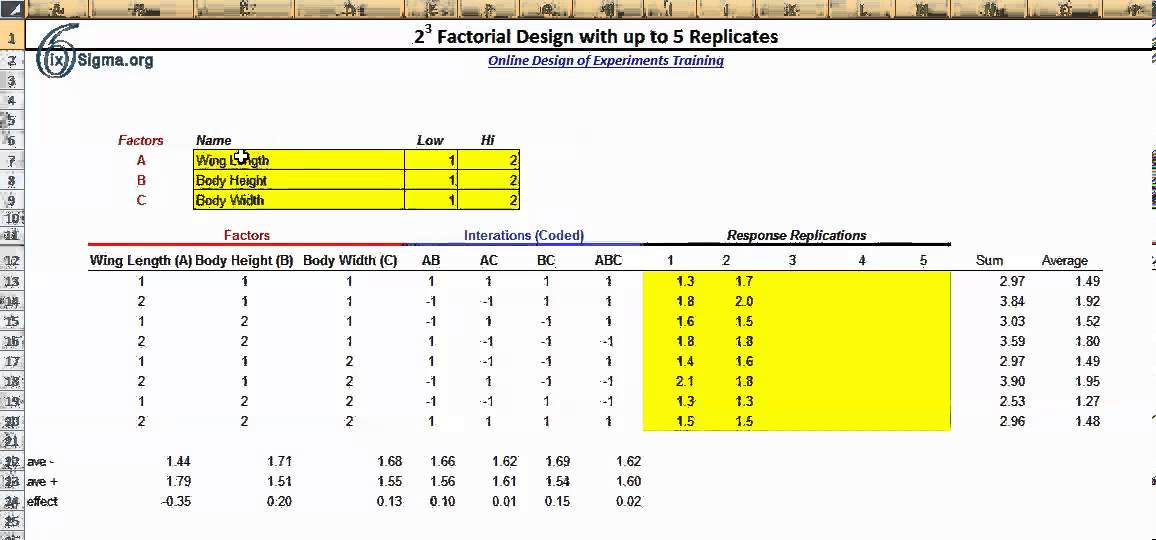
For example, with two factors each taking two levels, a factorial experiment would have four treatment combinations in total, and is usually called a 2×2 factorial design. In such a design, the interaction between the variables is often the most important. This applies even to scenarios where a main effect and an interaction are present.
We can apply the same reasoning in a 26 experiment to remove half the runs. In the 32-run 26–1 fractional factorial design there are 32 confounding relations (e.g., ABCDEF with the intercept, A with BCDEF, etc.), and, importantly, all of the main effects and two-factor interactions are confounded with four- and five-factor interactions. Given our assumption that these high-order effects are unlikely to be important, we have little worry that they will contaminate our estimate of the main effects and two-factor interactions.
For example, a researcher might choose to treat cell phone use as a within-subjects factor by testing the same participants both while using a cell phone and while not using a cell phone (while counterbalancing the order of these two conditions). But he or she might choose to treat time of day as a between-subjects factor by testing each participant either during the day or during the night (perhaps because this only requires them to come in for testing once). Just as including multiple dependent variables in the same experiment allows one to answer more research questions, so too does including multiple independent variables in the same experiment. For example, instead of conducting one study on the effect of disgust on moral judgment and another on the effect of private body consciousness on moral judgment, Schnall and colleagues were able to conduct one study that addressed both variables. An example is a study by Halle Brown and colleagues in which participants were exposed to several words that they were later asked to recall (Brown, Kosslyn, Delamater, Fama, & Barsky, 1999)[1].
The first run (as specified by the random run order) should be performed at the low levels of A and C and the high levels of B and D. The following Yates algorithm table using the data from second two graphs of the main effects section was constructed. Besides the first row in the table, the main total effect value was 10 for factor A and 20 for factor B. However, since the value for B is larger, dosage has a larger effect on percentage of seizures than age.
All participants could be tested both while using a cell phone and while not using a cell phone and both during the day and during the night. The advantages and disadvantages of these two approaches are the same as those discussed in Chapter 5. Just as including multiple levels of a single independent variable allows one to answer more sophisticated research questions, so too does including multiple independent variables in the same experiment.


No comments:
Post a Comment